

Professor Neville Hacker AM MD, Founder & Director AGCF, recounts the amazing story of Ms Brenda Farah Coleman, who travelled from the USA to Australia, in June 2026, to reconnect with her life-saving gynae cancer surgeon, Dr Neville Hacker, after 44 years…
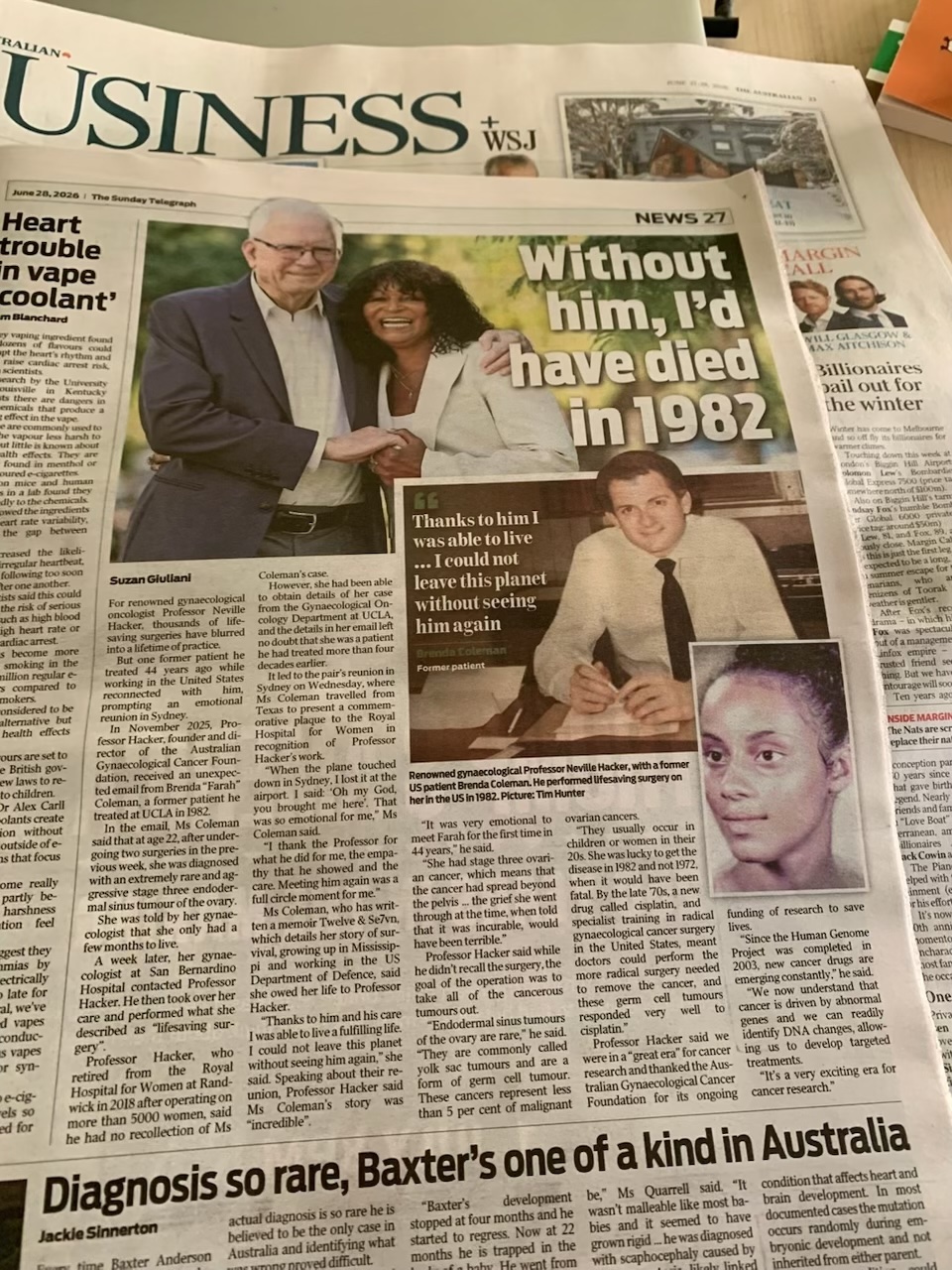
In November 2025, I was very surprised to receive an email from a woman named Brenda Farah Coleman, (known as Farah), who told me that I had treated her at the University of California, Los Angeles (UCLA) in October 1982 for a stage 3 endodermal sinus tumour of the ovary. She wanted to let me know that she had an autobiography forthcoming entitled Twelve and Se7vn, and that she would send me a copy in the new year. She told me that she had worked in multiple Departments of Defence, before retiring in late 2023, and that writing the book had been a long-term aspiration of hers. The book title was reference to her being the youngest of her mother’s 12 children, and of her father’s 7.
A hard-cover book of 235 pages duly arrived in March 2026. I must confess that I cannot remember Farah’s particular case, however, she was able to obtain all her records from UCLA, so the facts were accurate. On reading the book, it was heart-breaking to learn what this young woman had endured in the lead-up to her transfer to UCLA. I offer the following commentary with some excerpts from the book:
Farah grew up in Clarksdale, Mississippi, but at the time she developed her cancer, she was living in San Bernadino, California, with her sister, and doing a Banking Operations course at a nearby Technical College. Her first symptoms were of pelvic pain, particularly a feeling of pressure on the rectum. The pain was so intense that she went to the Emergency Room at the San Bernadino Hospital, where she was diagnosed with pelvic inflammatory disease. She was given antibiotics, but by the next day she was vomiting and feeling extremely weak.
She returned to the hospital, and after further tests, was told that she would need a “bikini incision to find out what was really going on’’. After the operation, she was told she had an infection in both her tubes, and she was prescribed more antibiotics and discharged. However, within a few days, she was too weak to stand, and was still vomiting. She returned again to the Emergency Room at San Bernadino Hospital, and after further tests, the gynaecologist told her that she would have to have a hysterectomy (at the age of 22!). Feeling desperately ill, Farah agreed to have the surgery.
She underwent surgery via a lower midline incision. Post-operatively, days went by and she had not seen her surgeon for a discussion about the findings. Two of her siblings and in-laws visited her, and she noticed that they were wearing sunglasses and appeared anxious. She told them she had still not seen her surgeon, and they said he may have come while she was asleep.
Eventually, she was visited by a woman, probably a palliative care nurse, who started talking about things that made no sense to her. When the woman realised that Farah was confused, she left, leaving her card on the bedside table. Farah rang the phone number on the card, and asked why the woman had visited her. She was told “You have advanced ovarian cancer and cannot be cured. Treatment is focussed on improving comfort and, when possible, increasing life expectancy”.
Farah immediately screamed and dropped the phone, prompting nursing staff to rush to her aide. She demanded to see her operating gynaecologist, who eventually arrived, along with her family. Before arriving, he had ordered tranquillizers, but Farah refused to take them. Everyone was in tears, including the doctor, who told her he was sorry several times. He explained: “I tried so hard, but the cancer is severe, and there’s nothing I can do.”
Her sister later told Farah that the doctor told the family that he couldn’t bring himself to give her the diagnosis and had asked them to do so, but they had also been unable to face the conversation.
A few days later, on a Friday evening, the gynaecologist returned to see Farah with her family. He told her that he had spoken to me at UCLA, and that she would be transferred there under my care on Sunday evening. We subsequently undertook an extensive operation, necessitating resection of some small and large bowel, and were able to remove all the cancer. She then underwent chemotherapy, followed by a “second look”, an operation we no longer perform. Fortunately, Farah remains very well, and able to tell the story 44 years later.
After reading the book, I thanked Farah for thinking of me after so many years. She told me she was planning to come and see me later in 2026, and that she would like to meet the Chair and CEO of the Australian Gynaecological Cancer Foundation. She also said that she wanted to present a Plaque to the Gynaecological Cancer Centre at the Royal Hospital for Women.
Farah arrived in Sydney from San Antonio, Texas, on Tuesday June 23rd, and I flew to Sydney the following day to meet her. Our meeting, which was very emotional, was captured by the Channel 10 news.
After an interview with the Daily Telegraph, I accompanied Farah to the Royal Hospital for Women, where she presented the plaque to the Director of the Gynaecological Cancer Centre, Dr King Man Wan. She then met with the President of AGCF, Ms Di Langmack, OAM, and the CEO, Ms Georgina Laverty-Bill, for afternoon tea. Farah is hoping to be able to support the Foundation in the future.
The day after Farah’s arrival, she was joined by her niece, Sheila, who accompanied her for the rest of her visit. On Friday June 26th, they both flew to Brisbane, and my wife and I have had the pleasure of showing them around south-east Queensland over the week. This included visits to the Gold Coast, The Brisbane Jazz Club, and the Lone Pine Koala Sanctuary.
It has been very interesting for me, and I think cathartic for Farah, to reflect on her battle with advanced germ cell cancer of the ovary 44 years ago. She brought all her notes from UCLA with her, so I was able to fully understand what treatment she had been through at the time, and answer many questions for her. It is interesting that there have been many advances since that time, which have all occurred because of breakthrough research.
Prof Neville Hacker AM MD, Founder & Director AGCF